


Every processing line has the same basic goal: move more good product through the line while removing material that does not meet specifications.
How you get there depends on what you are processing and what you need to separate.
That is why the question is not necessarily whether mechanical sorting or optical sorting is better.
The better question is: What does your material need?
What mechanical sorting does
Mechanical sorting separates material based on physical characteristics.
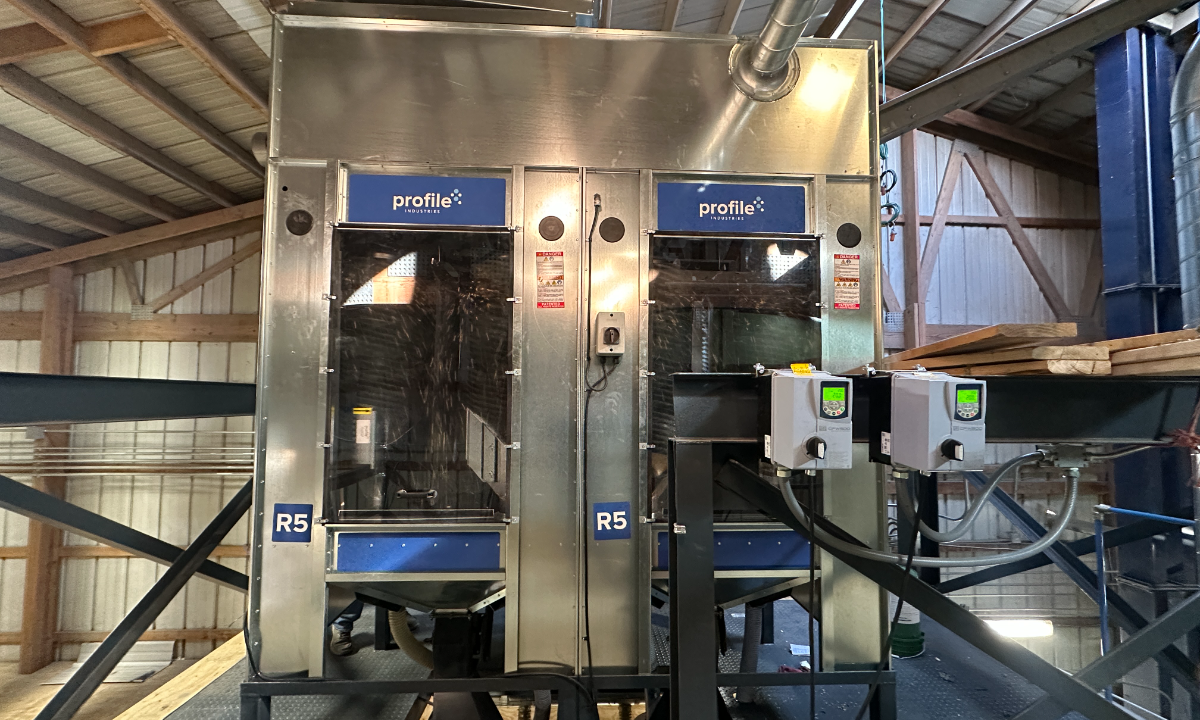
Profile’s Rotary Spiral Separator uses differences in shape and movement to create separation. As material travels down the spiral flights, round material gains momentum and moves toward the outside. Flatter, split, and irregular material moves differently and remains toward the inside.
In seed processing, that makes it possible to separate good round seed from splits, misshapen seed, and other irregular material without relying on cameras or electronic detection.
What optical sorting does
Optical sorting evaluates material in a very different way.
Profile’s optical sorting technology includes capabilities such as color, measurement, defect detection, quality inspection, smart learning, and material analytics to identify material that does or does not meet the required specifications.
That makes optical sorting valuable when the characteristic you need to identify cannot be separated through physical shape and movement alone.
Where each technology fits
Mechanical and optical sorting are not necessarily competing technologies.
They solve different processing challenges.
Mechanical sorting may efficiently remove material based on physical shape. Optical sorting can then evaluate characteristics that require imaging, measurement, inspection, or more detailed detection.
Where each belongs depends on the material being processed, the quality specification, the volume moving through the line, and the problem the processor is trying to solve.
Why the right combination matters
Asking one piece of equipment to solve every sorting problem can make the entire process less efficient.
When different technologies handle the tasks they are best suited for, processors may be able to:
- Recover more usable material
- Reduce unnecessary rejects
- Improve product quality
- Increase processing capacity
- Reduce bottlenecks
- Make better use of downstream equipment
The goal is not to add more equipment. It is to build a process in which each piece of equipment has a clear job.
What this looks like in a processing line
Hefty Seed Company added mechanical shape sorting ahead of its existing color sorter. Afterward, that color sorter was reported to fire on 50% fewer beans.
That means less material reaching the next stage that could have already been separated mechanically.
Hurt Seed in Halls, Tennessee, had a different challenge. Even with a cleaner, gravity table, and downstream sorting equipment in place, the line was not reaching its designed capacity.
After adding mechanical shape sorting, the line reached its designed capacity, a reported 20% improvement. The equipment achieved approximately a one-year ROI.
The lesson in both cases is not that one sorting technology replaces another.
It is that the entire process needs to work together.
Start with the material
The right sorting solution begins with understanding what you are processing, what needs to be removed, what needs to be recovered, and what result you need at the end of the line.
That may mean mechanical sorting. It may mean optical sorting. In some applications, it may mean both.
Profile offers standard, configurable, and custom-engineered solutions designed around the material, specifications, and processing requirements.
Find the right sorting approach
Not sure where the bottleneck or quality issue is in your processing line?
Talk to Profile about your material, your process, and the result you need. Our team can help determine which sorting approach makes the most sense for your application.